
WP2
Hyperpop and its Relationship with Queer Culture

DISCLAIMER:
I wanted to highlight that while there are only seven sources listed, most of them are multiple pages full of very specific information on my topic. For example, two of them are thesis papers that analyze queer and Hyperpop culture extensively in a variety of contexts.
In addition, this will greatly focus on SOPHIE (who recently passed away in 2021) due to the general consensus that she was the most influential artist to establish Hyperpop as a genre.
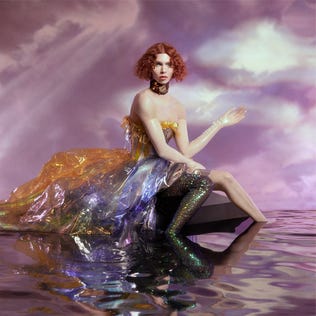
This assignment is dedicated to SOPHIE who truly changed the world and inspired everyone to live freely and true to themselves.
PART I: Annotated Bibliography
Holte, Lisa Karolyn. The Trans Girl and Her Computer: Vocal Processing and the Creation/Expression of Gender in Hyperpop. MS thesis. 2023.
In over 100 pages of Hyperpop history making up Holte’s thesis, I would like to focus on the chapter regarding Dorian Electra. Holte draws audience attention to Dorian Electra for their role as a gender ambiguous character compared to Laura Les who presents much more feminine. One track of Dorian’s highlighted by Holte, “Career Boy,” makes the listener perceive and gender Dorian differently depending on their vocals. Going from an effeminate voice to a deeper more masculine range plays with the ear of any listener in a sort of “genderplay.” To a listener, it feels like two entirely different singers while Dorian is playing both roles. The concept of this goes against a cisheteronormative society and shows vocal expression of gender and sexuality. Holte also mentions that it does not stop at their vocals. Dorian also switches between more feminine and masculine styles of dressing in music videos or real life allowing viewers to see their androgyny.
This thesis covers a variety of Hyperpop artists with the chapter on Dorian Electra being beneficial in covering a non-binary/gender-fluid trans identity in relation to Hyperpop.
Luce, Miles. "The “Gec-Effect": How 100 Gecs Renders Genre and Gender Absurd." Zenith! Undergraduate Research Journal for the Humanities 5.1 (2021).
This essay delves into the history of Hyperpop and how it rose to fame as an iconically queer genre. Hyperpop is rooted in “internet-core” with some of its predecessors being nightcore, lo-fi, emo, soundcloud rap, bubblegum pop, and a variety of other genres. Luce explains that hyperpop takes an alternative or “queer” approach to genre compared to most other music. Queer culture and Hyperpop are intrinsically tied together in such a complex due to both being notable for using a variety of styles to express sexuality and gender. Laura Les, who is openly transgender, uses vocal modulation to help express her identity even further in her music with band partner, Dylan Brady.
March, Lucy. “‘Wrap You Up in My Blue Hair’: Vocaloid, Hyperpop, and Identity in ‘Ashnikko Feat. Hatsune Miku – Daisy 2.0.’” Television & New Media, 2022, p. 152747642210935–, https://doi.org/10.1177/15274764221093599.
Hyperpop artist Ashnikko surprised fans and non-fans alike with her release of a collaboration with popular virtual idol, Hatsune Miku. Hatsune Miku being a beacon of Japan’s advances in music and Ashnikko being one of the top Hyperpop artists from the U.S. come together to create a significant cultural moment that blends worlds together. Author includes background of Ashnikko in addition to mentioning many queer Hyperpop artists such as Dorian Electra, Laura Les of 100 gecs, and the late SOPHIE.
While this article does not contain a lot of information regarding Hyperpop and queerness specifically, it introduces Ashnikko, who is another prominent figure in the queer and the Hyperpop communties.
Spencer, Edward. "On Internet Subcultures & PC Music (Part II): A Reappraisal." (2022).
In this blog post, Spencer introduces internet subculture alongside the UK record label PC Music. After explaining a variety of popular internet subculture social medias such as Discord, Reddit, 4chan, Spencer focuses on Hyperpop and PC Music. In regards to SOPHIE’s song “It’s Okay to Cry,” he states:
“if we consider the bigger picture by cross-referencing SOPHIE’s work with the lyrics, production features, and discourse of related artists as well as with testimonial comments authored by fans online, then the bonds between the PC Music and hyperpop phenomena and LGBTQ+ empowerment become unbreakable and impossible to ignore.”
For context, “It’s Okay to Cry” was sung by SOPHIE herself instead of a hired vocalist which further emphasized trans empowerment.
Spencer highlights another artist who is on the opposite spectrum of SOPHIE. In reference to Fraxiom’s music, Spencer states “Unlike in SOPHIE’s oeuvre, autotuned and pitched-up vocals are weaponised by Fraxiom in order to amplify deliberately hurtful lyrics that resemble . . . flame trolling and what I term target trolling.” In an interesting take, Spencer brings attention to one line of Fraxiom’s “fly with ü” which goes, “J. K. Rowling I’ll find you and say hello like Adele / Make that ***** ring her LifeAlert just like your grandma fell.” Spencer implies that it is supporting queer people through targeting those who actively work against the community.
Swoboda, Li De-Yan. "Sounds Queer: Gender and the Voice." The Undergraduate Journal of Sexual Diversity Studies (2022): 56.
In this journal snippet, Swoboda discusses the relationship between gender and voice. They mention SOPHIE as a “prominent trans musician and producer in the Hyperpop scene.” Swoboda highlights that most of SOPHIE’s works dealt with queer subject matter and worked against traditional ideas of what gender and sexuality should be. According to Swoboda, another artist is Big Freedia who emphasizes her deep voice to express her trans identity. They also mention more artists such as Chase Icon who focuses on trans feminism and sexuality, Shea Diamond who focuses on trans misogyny and racism, and more. While a few of them are not necessarily hyperpop artists, they help focus the point that gender and voice in music go hand-in-hand. Swoboda states that “transgender performers, or performers who forward a trans erotic, make use of the inherent queerness of sound to expose our falsified prescriptions of gender.”
This article provides context on other artists besides 100 gecs and SOPHIE and their influences on queer culture.
Williams, Patrick. Beyond the Binary: Digital Voices and Transhumanist Expression in Sophie's Oil of Every Pearl's Un-Insides. California State University, Long Beach, 2021.
For his master’s thesis, Williams focuses on Hyperpop artist SOPHIE who passed away in January of 2021 with the thesis being released in May of 2021. SOPHIE is considered the “figurehead and progenitor” of PC Music which is widely known for being the birthplace of Hyperpop. With SOPHIE taking the backseat in vocals, she recruits a variety of feminine to androgynous voices to sing on her tracks. One of the interesting points highlighted is that SOPHIE considers herself a transhumanist which is a branch of philosophy that promotes the use of digital technology to improve human life. Williams states SOPHIE uses Hyperpop to produce sounds that are impossible with the human body by itself.
One of SOPHIE’s earlier pieces, “LEMONADE,” starts off with fizzling noises similar to a drink being poured before hitting the catchy “le-le-lemonade” hook. It then proceeds into a very hyperfeminine voice that is human, but edited to sound almost-human. SOPHIE essentially uses the voice of Nabihah Iqbal as an instrument to further enhance the song and push a hyperfeminine sound that matches SOPHIE’s journey with being transgender.
Williams highlights another interesting track, “It’s Okay to Cry,” which comes from SOPHIE’s debut album, “OIL OF EVERY PEARL’S UN-INSIDES.” The title track “It’s Okay to Cry” features SOPHIE herself singing with little-to-no vocal editing besides pitch correction. In an interview mentioned, SOPHIE stated, “I just felt like I could use my body more as a material, as something to express through and not fight against,” which matches with the album’s concept of authenticity and self-love. In addition, the music video for this song features SOPHIE topless and showcasing her breasts to add onto the sense of freedom. It is also not age-restricted on YouTube which establishes she is “untethered from the burden of any external authority imposed on her physicality” according to Spencer.
This thesis included a large variety of info with a variety of focuses, so this is a strong piece to research.
"Wizards of Hyperpop." Rolling Stone, Feb. 2022, p. 10. Gale OneFile: Pop Culture Studies, link.gale.com/apps/doc/A738318149/PPOP?u=usocal_main&sid=bookmark-PPOP&xid=d2eac666. Accessed 8 Oct. 2023.
In this snippet of a Rolling Stone issue, 100 gecs are referred to as “Wizards of Hyperpop,” which is fitting as they don shiny SpongeBob-like wizard robes at most of their concerts. 100 gecs are introduced as a chaotic duo that creates “genre-exploding hyperpop albums.” During this period of time, 100 gecs was preparing to release their newest album in 2023, 10000 Gecs, which stands as a successor to 1000 Gecs from 2019.
This snippet does not necessarily contribute a ton of information, but it establishes 100 gecs as a part of mainstream culture now being referenced by the Rolling Stone.
PART II: Reflection
Considering my connection to Hyperpop runs deep, I simultaneously learned a lot and not much. Many of the papers listed contained information that I knew about even if I couldn’t recall it exactly. Instead, all of this information gathered proved to further validate my own experiences with this topic and act as a fact checker for my knowledge.
My knowledge on SOPHIE was vast from the start of this assignment as I have experienced her music since 2018 and unfortunately witnessed the day she passed away online. Many of my favorite artists, some of which who do not create Hyperpop music, have all worked with SOPHIE or have made hidden tracks with SOPHIE that are unreleased or released secretly on Soundcloud. Some artists she has worked with include Kesha, Kero Kero Bonito, and Kim Petras whom all of which have a vastly different sound and genre.
However, I did learn a bit more about artists I have listened to but not necessarily thought more about. Fraxiom, while I am familiar with their music, I have not listened to some of their more influential tracks. I considered their music “volatile” compared to other Hyperpop artists, but I did not ponder why. It was interesting to see that compared to SOPHIE’s softer take and emphasis on self-love and acceptance, Fraxiom promotes the idea of attacking your attacker and regularly calling them out. Personally, the J.K. Rowling line had me laughing as it was such a delightful surprise to see Fraxiom fight back against her in a way many of us Gen-Zers would consider “iconic.” With another artist, Dorian Electra, I have regularly listened to them and attended their shows, but I never thought about the depth of masculine / feminine vocal switches used by them to express a sense of gender-fluidity. When I look back at the songs now, I really sit and pay attention to how Dorian’s voice changes. It was also really cool to find out that most of the change in masculinity / femininity is by Dorian themselves without the aid of technology. This itself made me admire Dorian Electra even more as a fellow non-binary.
I also found it very interesting that the ties between Hyperpop and queer culture are essentially inseparable. In my personal experience from attending many Hyperpop shows and events, I have seen an influx of presumed cishet individuals appear and cause issues for those in the queer community. With that in mind, it is intriguing to see how a safe space based in queerness can be taken over by another group who just considers it “cool and trendy” without realizing how important the space that Hyperpop created is for the queer community.
For my current view, I still believe Hyperpop is a queer-coded genre in nature. Even if non-queer artists can recreate it and emulate it, there is a huge portion that simply only the queer community can put in emotionally. Many 100 gec songs would not be as fulfilling or inspiring if Laura Les was not transgender, Dorian Electra songs would not relate to me as much if Dorian was not non-binary, and SOPHIE would no longer have as large of an impact on individuals if she was not an openly transgender woman. Many of the emotions and lyricism tied within Hyperpop songs tell a story of queer livelihoods and I believe that is an extremely important story to get out. While I enjoy the mainstream nature of some Hyperpop artists, I do not want the original intention to be undermined and I still want the safe spaces created to be protective of queer people.
The genre of writing that best fits showcasing my views and knowledge is an op-ed. It is ideal as it allows for me to get personal with readers and give my true thoughts and opinions. It would also let me include hyperlinks and give my readers the sense that they are researching alongside me.
I will state that while I enjoyed this topic thoroughly, I do not anticipate writing about this topic again for WP3. I have another topic I am dying to write about, so I am excited to showcase it for WP3. I will create an op-ed, but in a different topic which for now, to not spoil it, will likely incorporate the concepts of nostalgia and Y2K. I hope to expand upon the reemergence of Y2K and write about one or two of my current favorite artists that heavily make me feel nostalgic towards my childhood in a more glorified, idealized way.